This site is still being polished, especially on mobile and smaller screens. Some things may not look perfect just yet.
Care of God’s Creation
Stewardship for the planet is an important facet of our 100+ year of work in mission to share God’s love and the Gospel in combating poverty, providing healthcare, building communities, promoting human rights and protecting the earth’s resources.
Maryknoll missioners have been privileged to serve God’s people in many corners of the earth, most often on the margins with the people who are excluded from tables of power and w hoe lives are considered expendable in the dominant economic system. This lived experience of our missioners informs all of the statements of the Maryknoll branches – The Maryknoll Fathers and Brothers, the Maryknoll Sisters and the Maryknoll Lay Missioners.
Laudato Si’, Pope Francis’ encyclical on the environment, is a clarion call for a personal conversation within each of us, as building blocks, to shape a world governed by sustainable economic policies and environmental protections. Pope Francis emphasizes that it is not enough for us to go through the motions of change; we are in need of a cultural overhaul and a spiritual revolution.
Individualism and rampant consumerism have led to decisions based on short-term gains and private interests rather than sustainability or the common good. This personal conversion encompasses a re-evaluation of our personal priorities and actions and branches out to a renewal of our commitment to our families, our communities, our faiths and all of God’s creation. “We must regain the conviction that we need one another, that we have a shared responsibility for others and the world, and that being good and decent are worth it.”
Around the world, Maryknoll missioners see how families, communities and the environment suffer due to choices made in faraway places, often by people who have never visited the affected locations. The encyclical emphasizes the often overlooked principal of subsidiarity. As much as possible, political decisions should be made at a local level by the people most affected.
Pope Francis in particular underscores how our economic policies contribute to poverty and environmental degradation and that we must consider a new vision of the economy that recognizes Earth’s limits.
Reducing Maryknoll’s Own Ecological Footprint
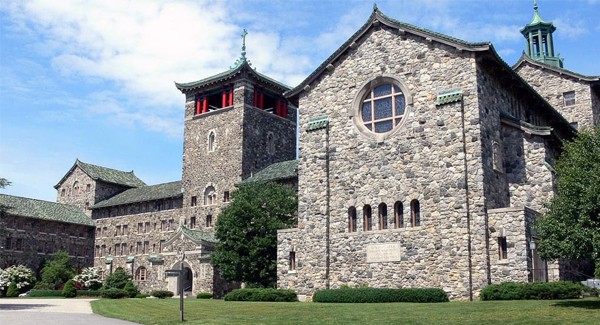
The Maryknoll home on a hill in Ossining is dominated by the 210,000 square-foot H-shaped Maryknoll Mission Center building that was built from fieldstone and started during the 1920s. The campus is a work environment, the center of activity for Maryknoll’s worldwide mission work, the home of its missioners and for those who require assisted living and elder care.
For over a decade, we’ve committed ourselves to an ambitious green initiative to overhaul many facets of our campus to be far more environmentally friendly.
Within the last several years, the Procurement, Facilities Management and Custodial Services departments within Maryknoll have embraced the stewardship initiative and implemented operational changes to reduce the Society’s ecological footprint on the property originally known as Sunset Hill. The property and the Maryknoll Society received its modern-day name from co-founder Father Thomas Frederick Price’s dedication to the Virgin Mary and the topography of the land.
Energy-savings changes on the campus include updated heating and electrical systems, as well as building infrastructure improvements. In 2008, Maryknoll’s General Council made the decision to begin converting utility-supplied conventional electricity to wind-generated energy. Initially, wind produced 51 percent of the electricity purchased from the utility to power the Maryknoll Mission Center building, but now this building runs 100 percent on wind generated power. The resulting ecological benefit is a 50% reduction in carbon dioxide emissions.
Besides the “gone with the wind” conversion that delivers higher initial costs than conventional fuel-powered electricity, Maryknoll has found additional opportunities to improve energy efficiency in many of its buildings, specifically those constructed prior to 1970.
Windows have been upgraded from single-pane glass to double-insulated glass to reduce energy loss during winter heating and summer cooling periods. Biodegradable floor tiling was added during the renovation Bishop James A. Walsh building, originally constructed in 1915 and named after one of Marykoll’s co-founders.
Coupled with these architectural renovations, Maryknoll has installed energy- and water-efficient washing machines and dishwashers, low-flow toilets and shower heads that minimize water flow. Heating system updates are being researched which will improve the trapping and recycling of steam, positively affecting water efficiency. Even lights have been gradually replaced with more efficient housings and bulbs.
Cleaning chores have also been placed on Maryknoll’s environmental improvement list.
Maryknoll’s Custodial Services department has introduced low-suds, dye-free detergent for laundry and EPA-approved, biodegradable cleaning products derived from renewable resources, such as fruits, soybeans and corn. The change has reduced reliance on products that contain ammonia, bleach and phosphorous. Paper products are bleach-free and consist of 80 percent recycled content.
For trash disposal, Maryknoll switched from heavy density plastic liners to low density products to remove lightweight waste. Lower density liners use less fossil fuel in the manufacturing process. In an effort to always find “greener” solutions, Maryknoll’s Procurement department is currently researching the viability of biodegradable trash can liners. The Society also recycles paper, cardboard, various plastics and metals.
Within the workplace, Maryknoll’s 32 Xerox network color copiers use acid-free paper and cartridge-free technologies that employ compact and non-toxic color solid ink sticks. The machines reduce the amount of copier office waste by 90 percent when compared with similar color laser products.
For years, supporters of Maryknoll and its work in mission have witnessed the green initiative first hand and, literally, in their hands, with the bi-monthly delivery of Marykoll magazine and the Spanish-language magazine, Misioneros. Maryknoll began printing its magazines on paper stock with recycled content and with recyclable soy based inks in 1995.
Paper stock for each issue is procured from land certified by the Forest Stewardship Council, which is part of the Rainforest Alliance. The process prevents destruction of valuable forests by encouraging reseeding and replanting.
In the Print Shop at Maryknoll, which creates smaller documents, prayer cards and fundraising mailers, the amount of caustic chemicals for cleaning the presses has been reduced for some of the equipment and totally abandoned for other machines. Recycled paper, soy and vegetable-based inks, and fewer toxic chemicals to clean machines now are found in the shop’s inventory.
In mission countries, many Maryknollers fulfill their work by traveling on mules, horses, or bicycles. Back home, when they are assigned to visit parishes and schools to educate Catholics about mission, they have started to rely on hybrid cars.
The Maryknoll green initiative also extends into partnerships with outside contractors such as Flik Hospitality Group, the food supplier that provides 3,210 meals each week for the priests and Brothers who live and work at the Maryknoll Mission Center, as well as lunch for more than 200 employees. The kitchen is outfitted with energy-efficient equipment that, over time, have reduced energy costs. Most recently, plastic utensils have been replaced in food service and break rooms with vegetable-based products.
The reenergized commitment by Maryknoll leadership and its employees to conserve and protect the environment is an important part of the mission spirit fostered by the Maryknoll Fathers and Brothers. Employees are educated through articles provided by Maryknoll’s Eco-Mission team, published in their quarterly Newsletter. Stewardship is closely aligned with the commitment to help the poor and the underserved around the world, which is evidenced by Maryknoll’s commitment to be green and environmentally responsible.